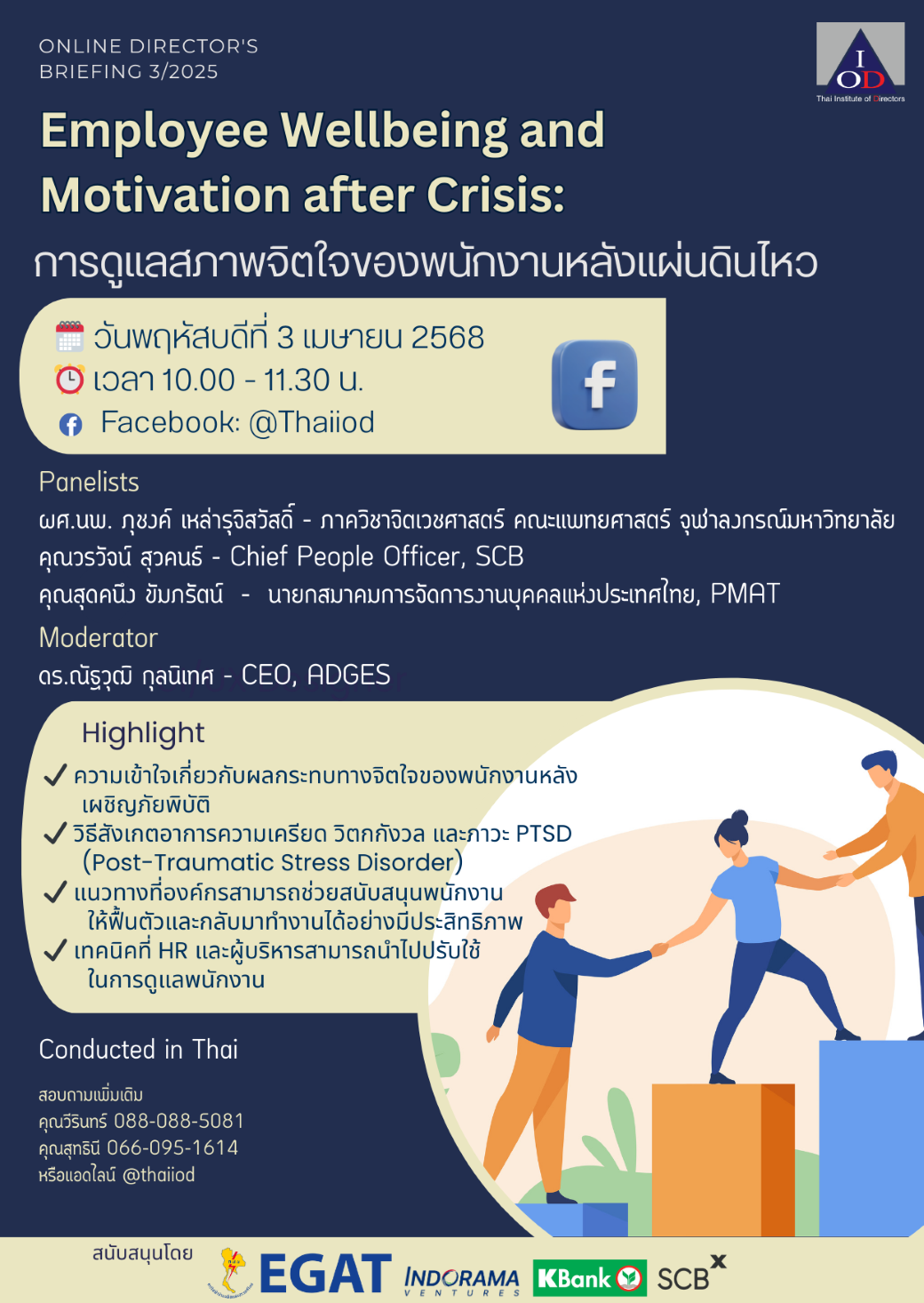

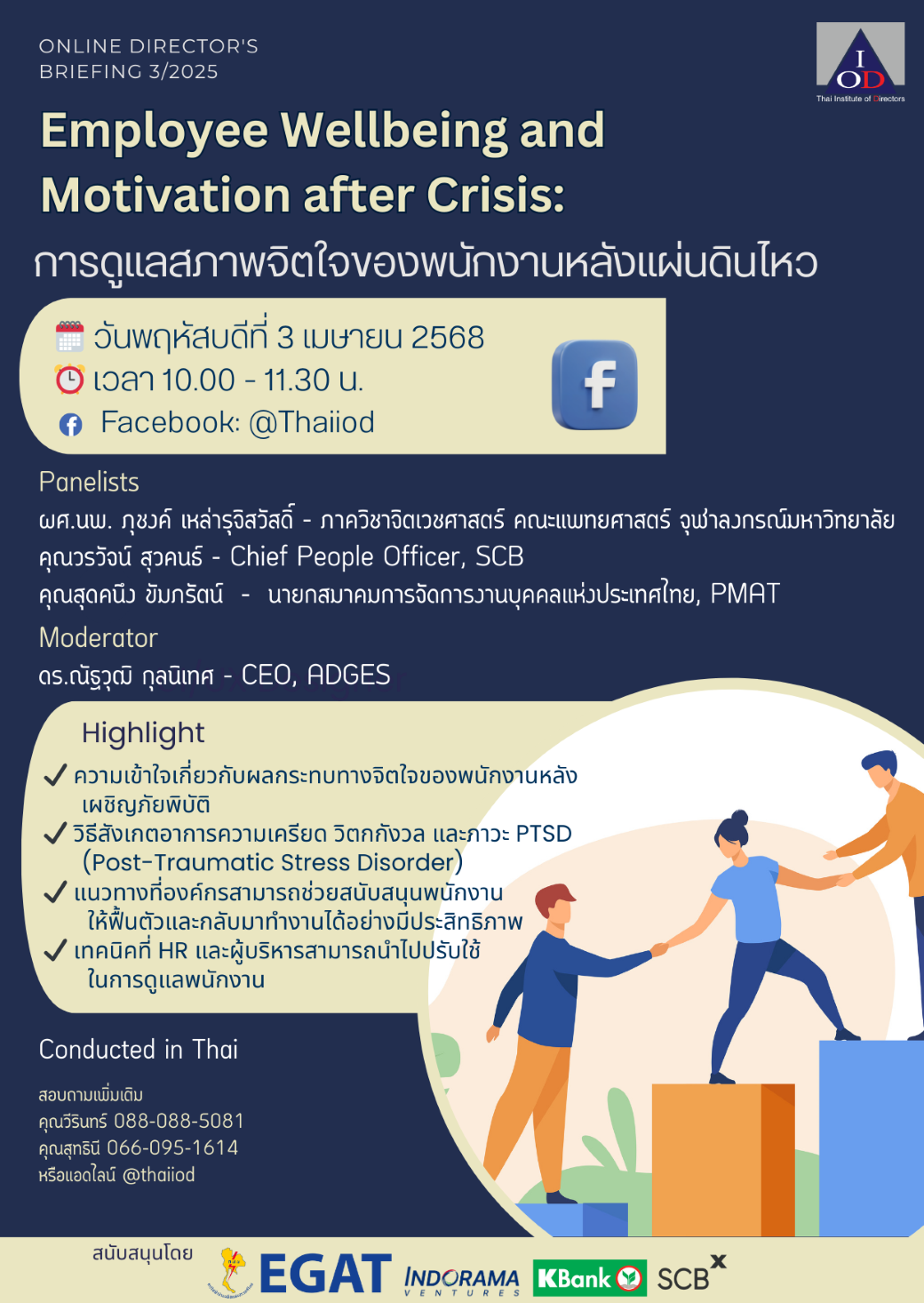
If you missed registering for Online Director's Briefing 3/2025: Employee Wellbeing and Motivation after Crisis: Caring for Employees' Mental Health after the Earthquake
 You can watch it on Facebook Live: @ThaiIOD
 Key takeaways from the Online Session on "Employee Wellbeing and Motivation after Crisis: Caring for Employees' Mental Health after the Earthquake"
 Asst. Prof. Puchong Laorujisawat, M.D. - Department of Psychiatry, Faculty of Medicine, Chulalongkorn University
 After an earthquake, feeling “insecure” is natural and happens to everyone, because the human nervous system works to protect us and keep us safe. Such feelings are therefore not considered abnormal in any way.
While employees still feel afraid, the organization should not focus on restoring productivity right away. It should first work on rebuilding their confidence, by making sure the workplace is safe and the building is properly maintained. Clear HR policies also help employees feel secure and safe again.
In the early period the nervous system may read events negatively, so what matters is creating a positive atmosphere. Holding activities such as a gathering gives employees the sense that they are cared for and protected, and helps them feel safe again.
On the first night after the event, employees may have trouble sleeping or feel uneasy, which is normal. What matters is following up over the longer term, 1-3 months after the event, to see whether any symptoms are still affecting their mental health.
If after 1-3 months employees still cannot go about their lives as usual, there is a risk of developing PTSD (Post-Traumatic Stress Disorder). Some may look for a way out by using alcohol to relieve the stress.
PTSD may gradually improve within 3-5 years, but the employee's nervous system can remain sensitive to triggers. If the employee keeps feeling anxious or emotionally unsettled, medication to ease the symptoms may be one option.
Where employees still carry anxiety or accumulated stress, HR may need to observe them and offer help in various forms, such as arranging psychiatric counselling for them.
Seeing a psychiatrist is always an option. If the person does not have a disorder, the psychiatrist will tell them so and advise on what to do next.
Mr. Worawat Suwakhon - Chief People Officer, SCB
After the earthquake, what employees expect from their organization is as follows:
 Clarity: transparent communication, such as a policy on not entering the building for safety reasons, and a clear announcement of when employees may return to it
Confidence: for example, closing the building so that engineers can inspect it until there is certainty that the structure has not been damaged
Encouragement: since many employees may have had to leave their homes, HR should have measures to help with those costs so that employees feel cared for
The right HR approach during a crisis is to respond in a timely / rapid and flexible way, while showing empathy by understanding how employees feel
The key lesson from this crisis is that organizations should treat employee Well-Being as one of their core strategies, because it builds Resilience for the organization over the long term
Well-Being covers Health Well-Being, Financial Well-Being, Cultural Well-Being and Spiritual Well-Being, which together form the foundation for building security and happiness for employees
Cultural Well-Being means executives making decisions that put employee safety first and taking responsibility for their care
Leaders must believe that Resilience and Well-Being are part of the organization's Competitive Advantage, and must act as a Role Model in promoting them
Organizations should also give importance to Mindfulness training so that employees stay self-aware, which supports good decisions both in normal times and in a crisis
The heart of encouraging employees is building a Coaching Culture, meaning that managers and employees have time to talk about their concerns, both at work and personally. This matters especially now, when employees may still be anxious after the earthquake; talking with them eases that anxiety and strengthens the relationship
Organizations must also pay attention to observing employees' emotions, especially at a time when some may show signs of depression. SCB therefore set up a psychologist hotline to counsel and support employees whenever they need it
What organizations should do from here includes:
Executives should review how employee Well-Being was looked after during this crisis, and how appropriate and effective those actions were
Giving importance to collecting key information from the period after the earthquake, so that it can be analysed and used to improve operations in future
Organizations should have an effective channel for listening to employee feedback, so that what they learn can be used to manage future crises
Executives and HR should meet to review what was done well and what still needs improvement in handling the recent crisis, including whether the BCP they had prepared fully covers such events
 Ms. Sudkanueng Khampharat - President, Personnel Management Association of Thailand (PMAT)
Under Maslow's theory, employee safety must come first. HR must give support in both life and work so that employees feel safe, while keeping Diversity in mind, since each employee is facing a different problem: some have to be a mother, while others may have had to leave their homes
HR needs to build its own strength before it can help others, by staying mindful and caring for its own mental health first, because HR can help employees through Policy, Practice and appropriate advice
The ways HR can support employee Well-Being, across 7 areas, are:
Physical Well-Being: encouraging employees to prepare themselves physically for good health
Emotional and Spiritual Well-Being: using mindfulness, pausing to think and practising breathing to care for the emotions and the mind
Social and Environmental Well-Being: creating a working environment that supports good Well-Being
Financial and Occupational Well-Being: supporting employees to return to work in the best possible condition, for example by announcing a Work from Anywhere policy
HR's role from here is to push Well-Being so that executives see how much it affects employees, and to develop leaders in Empathy, Support and Resilience, building strength and flexibility for both the organization and its people over the long term