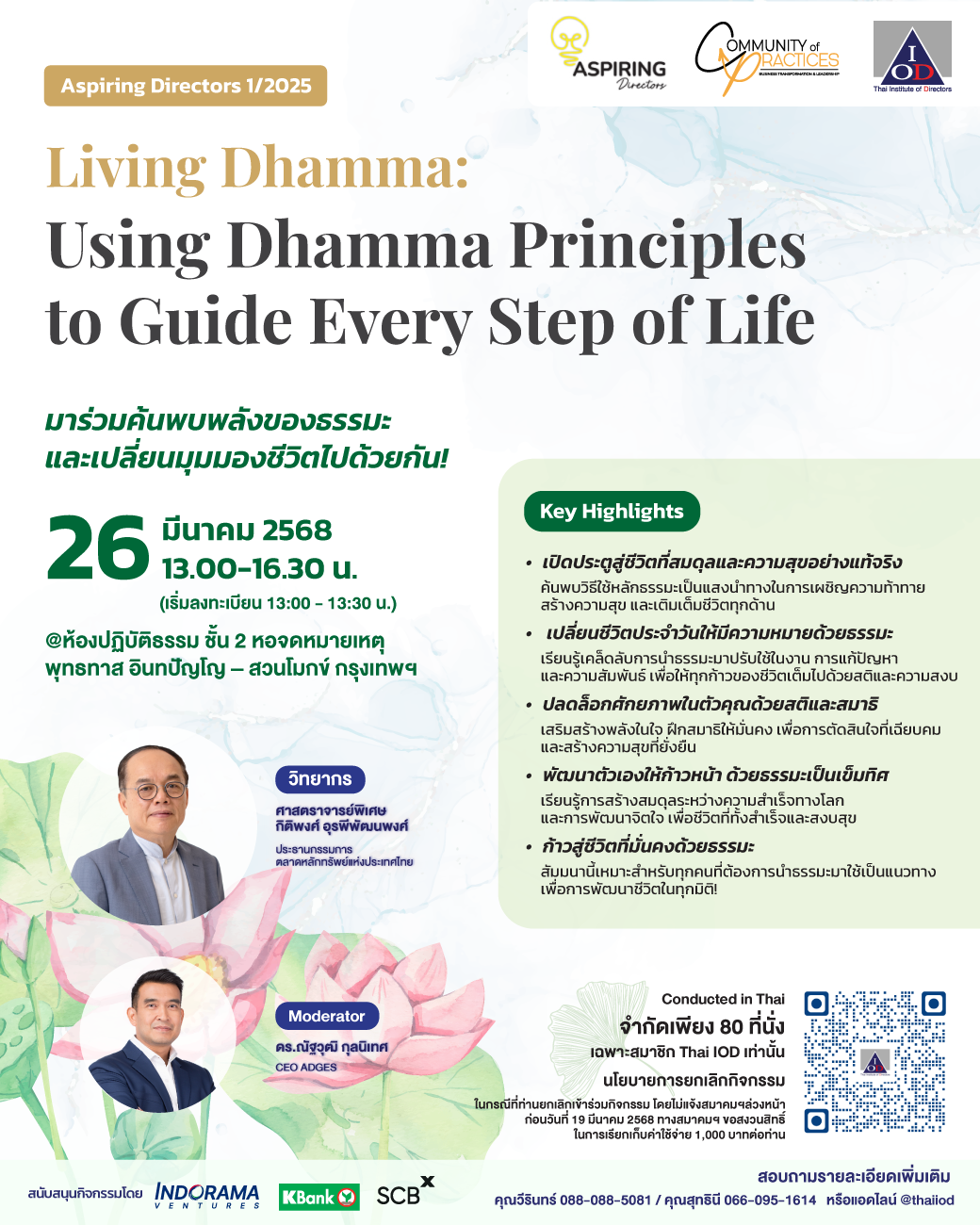

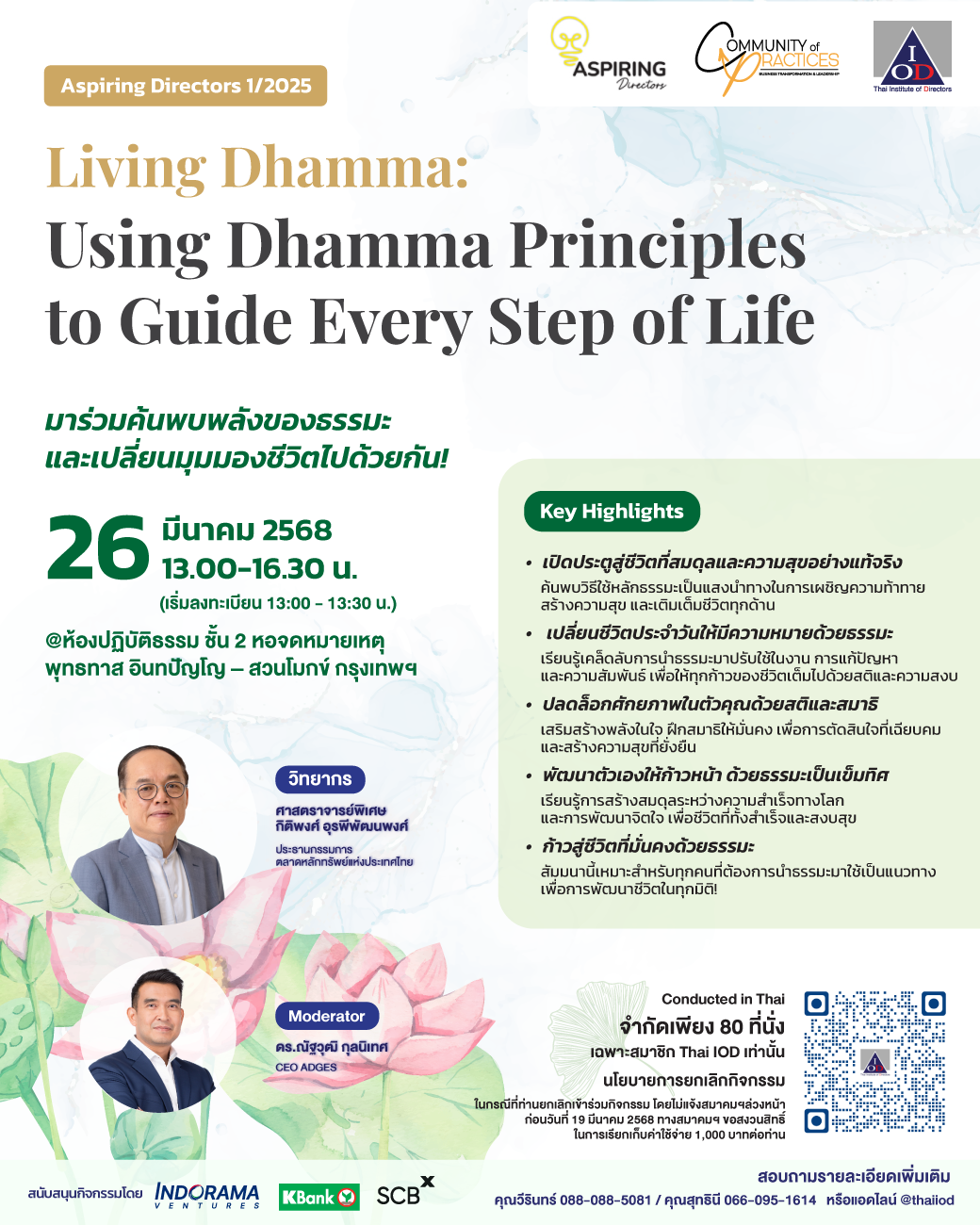
10 lessons from the first Aspiring Directors session of the year, on the topic Living Dhamma: Using Dhamma Principles to Guide Every Step of Life, held at the Buddhadasa Indapanno Archives – Suan Mokkh Bangkok, honoured by Adjunct Professor Kitipong Urapeepatanapong, Chairman of the Stock Exchange of Thailand, and Dr. Nattavut Kulnides, CEO of ADGES, who joined the discussion
.
 Seeing suffering, seeing the Dhamma: as a child, Ajarn Kitipong had no understanding of religion at all. Although he read many Dhamma books, he could not reach their deeper meaning, until he met suffering in his own life, which became the starting point of his decision to go and practise the Dhamma
.
 A liking for work that serves the common good: Ajarn has consistently given his time to public work, because he sees that a life lived for others helps us live peacefully, mindfully and usefully to society
.
 The Dhamma principles Ajarn applies in daily life
o The Four Noble Truths (suffering, its cause, its cessation, the path): finding the root cause of a problem and truly understanding how to remove it
o The Four Brahmaviharas (loving-kindness, compassion, sympathetic joy, equanimity): having loving-kindness and helping others with compassion creates balance in life and in society
o The Four Iddhipada (aspiration, effort, attention, investigation): having aspiration, a passion for what you do, is the starting point that leads to success in life
.
 The mistakes in Ajarn's life: he learned from two mistakes. One was a strong ego, particularly around the age of 40, when success came to him quickly. The other was giving too little time to his family, which he came to regret, because the family is the institution that gives love and is the true source of strength
.
 Reducing the ego: the Dhamma is a tool that helps us review ourselves. Youth may be full of wanting and having, but at some point we have to set down the mask, because all of it is impermanent
.
 Love is life's energy: every life meets crisis and loss. If we have loved ones beside us giving us their love, that love becomes the strength that carries us through, and an inspiration to do good for society as well
.
 Love, disappointment and loss: over the past ten years Ajarn has faced the loss of people close to him, which taught him that preparing for loss is necessary, that we must ready our hearts and meet it with mindfulness and understanding
.
 Living Will: having faced the loss of those close to him, Ajarn Kitipong became one of the people working to help society understand the importance of making a Living Will, so that we can plan the final stretch of life's journey
[Note: a Living Will is a document declaring in advance that one does not wish to receive health services that would merely prolong dying in the final stage of life]
.
 Applying the Dhamma to the director's role: if directors have the Dhamma in their hearts, they will choose to do what is right. At the very least, what directors should hold to as a guide are the Four Iddhipada and the Four Brahmaviharas, which help them act with mindfulness and fairness
.
 The legacy Ajarn wants to leave: those who have already succeeded should give importance to giving, both knowledge and time, because when we know how to give we help reduce inequality in society. And what the giver receives, again and again, is the joy that comes from doing good and helping others
.